
How it works
Continuous patrol, careful recovery, complete records.
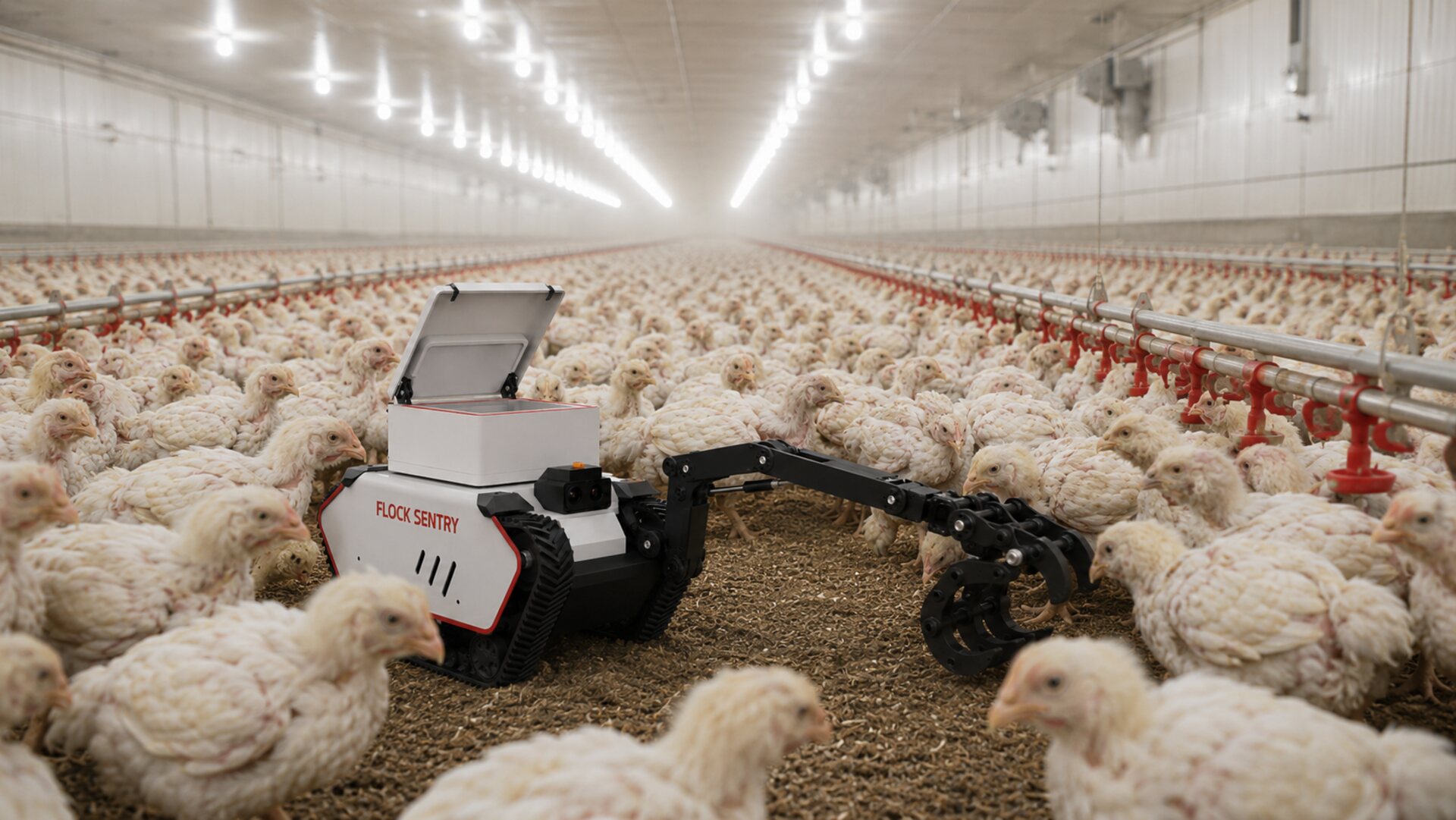
Flock Sentry replaces the daily mortality walk with always-on autonomy. It maps the barn, patrols every alley, confirms each carcass before it acts, recovers what it can safely reach, and flags the rest with location for a person. The result is a near-real-time biosecurity service instead of a lagging, labor-heavy chore.
Patrolling nowThe recovery cycle
Six steps, repeated continuously, day and night, with no human in the barn required.
Detect and confirm
On-robot AI classifies objects on the litter into carcass, live bird, obstacle, or uncertain. Before any grasp, a confirmation behavior observes for motion and, if needed, applies a gentle, size-scaled nudge. Any sign of life aborts the pickup.
Reach under the lines
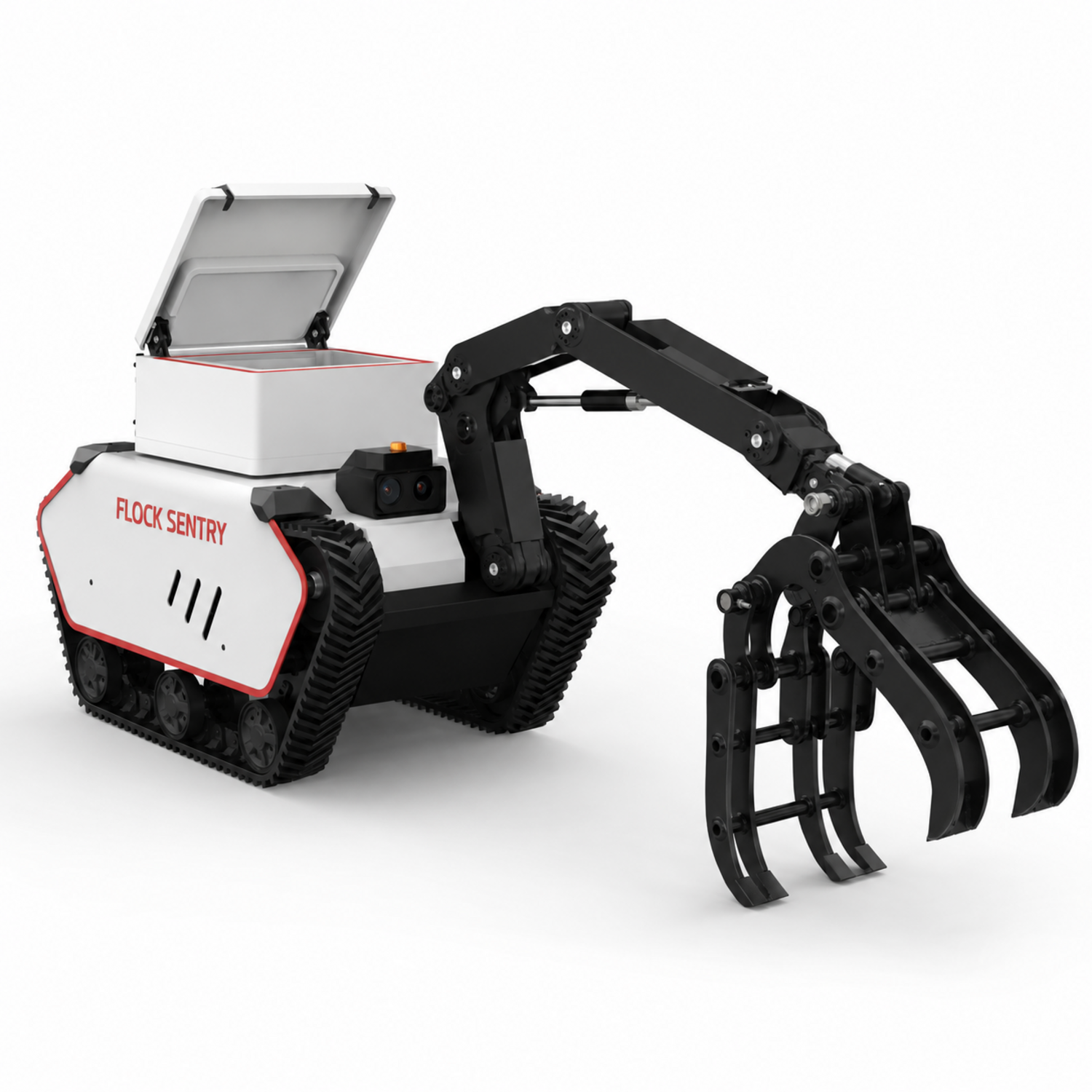
The robot stops in the alley and extends a low-profile arm up to about 0.8 m per side. Heavy or deep carcasses are first drawn inward with a rake before lifting, keeping everything below the low line clearance.
Gentle grasp
A conforming, force-limited gripper isolates one floppy carcass from loose litter and from adjacent live birds, handling the full 40 g to 3.5 kg range in any posture, including birds found on their backs.
Batch in the sealed bin
Each carcass is placed in a sealed, leak-proof bin that contains fluids and odor. The robot keeps patrolling and collecting rather than returning to base after every bird.
Tip at the drop-off
On a full bin or end of route, it navigates to an operator-configured drop-off zone, tip-empties completely, and confirms the bin is clear before resuming.
Auto-recharge
When charge runs low it returns to its dock, tops up to working level, and continues the coverage plan. Opportunistic top-ups keep duty effectively continuous.
Perception that works in dust and darkness
Detection runs entirely on the robot, with no dependence on barn connectivity. A multi-sensor suite is built to hold its targets from full-house lighting down to a 0 lux blackout, and to degrade gracefully rather than go blind when optics foul.
Multi-modal sensing
An RGB-D depth camera, LiDAR, long-wave thermal, near-IR illumination, and mmWave radar cross-check each other so detection survives dust and darkness.
On-robot AI
An NVIDIA Orin-class compute module runs detection, classification, and the grasp decision offline, in real time, at patrol speed.
Hard cases handled
The model is designed to find tiny buried chicks near brooders and carcasses up to half-occluded under low lines, reporting each with location.
Self-diagnosing optics
The robot detects an obscured or degraded lens and raises a clean alert rather than continuing blind, with self-cleaning windows between services.
Welfare guardrail
It will never knowingly grasp a live bird
The governing design intent is zero autonomous pickup of a live bird. The system is biased to miss a carcass and route it to a human rather than ever grasp a living bird. No grasp is authorized on the AI score alone, a physical confirmation is always the final gate.
Confidence banding
Each candidate is scored and routed: high confidence proceeds to confirmation, mid confidence goes to human verification, low confidence is observed and logged only.
Confirmation behavior
High-confidence candidates are observed for respiration and micro-motion, then optionally given a single, gentle, size-scaled nudge. Any motion reclassifies the bird as live.
Override guardrail
A live indicator at any point through grasp completion aborts the pickup, retracts the arm to a safe stow, and logs the event. The guardrail overrides the AI score.
Auditable decisions
Every detection, confirmation, and abort is recorded with imagery, score, and outcome, so any decision can be reconstructed for welfare audit.
Full-coverage patrol, calm by design
Flock Sentry maps the barn during commissioning, then plans provably complete coverage of every alley. It drives the lanes between feed and water line groups, reaching under the low lines from each side, and stirs the flock simply by being a calm, predictable presence.
Complete coverage
Boustrophedon path planning targets at least 99% of accessible floor per sweep, re-planning online as lines winch up or partitions move.
Drift-resistant localization
Sparse fiducials every 10-20 m anchor position in the long, featureless tunnel where LiDAR alone would drift, with darkness- and dust-robust markers.
Yields to the flock
Smooth, jerk-limited motion under 0.45 m/s slows near birds and gives way rather than pushing through, to avoid panic and piling.
Passive flock stirring
Continuous presence encourages birds to rise and redistribute, with non-movers logged as mobility and health flags, no lasers or sirens involved.
Capacity by design
One robot per barn, plus human-assist when it counts
A single robot comfortably holds the target sweep cadence at baseline and busy-day mortality. Under a sustained spike, or when a carcass sits below the reach floor or beyond the served band, the robot clears what it safely can and raises an in-app human-assist alert with location, rather than forcing an unsafe move or silently falling behind. The single unit at sustained capacity, plus a person on the overflow, is the model by design.
Mission control for the barn
Flock Sentry is an autonomous robot that patrols your broiler house around the clock, removing mortality before it becomes a biosecurity risk.